Construction & property owners

Construction and property compliance support that keeps work moving.

One page, two sides of the same job. Site safety, RAMS and CDM support if you are building — independent checks, stage inspections and certificate audits if somebody is building for you.

Scaffolding and edge protection on a small residential construction site in Kent
Independent inspections on small and medium works

What most people don't realise

Small jobs carry the same legal duties as big ones.

  • CDM 2015 applies to every job.There is no minimum size. Every project needs a construction phase plan before work starts, even if it's just you.
  • On a home job, the client's duties often fall to you.If you're the only contractor, the homeowner's CDM duties pass to you by default.
  • You must be competent for the work you take on.Since October 2023, Building Regulations dutyholder rules expect you to plan, manage and monitor the work so it complies.
  • Generic RAMS won't protect you.A method statement copied from the last job is the first thing an HSE inspector, insurer or main contractor will question.

What it can cost you

HSE intervention fees, prosecution and fines, invalidated insurance, and losing work with main contractors who check your paperwork.

How we help

RAMS and construction phase plans written for the job in front of you, and site safety inspections that tell you what to fix before anyone else sees it.

RAMS and site safetyfrom £225
Book a free consultation

Opens Google's booking page. Pick a time, Google emails you a confirmation, and we ring you then. Free, about 15 minutes, no obligation.

What you get

A written report you can act on, not a vague opinion.

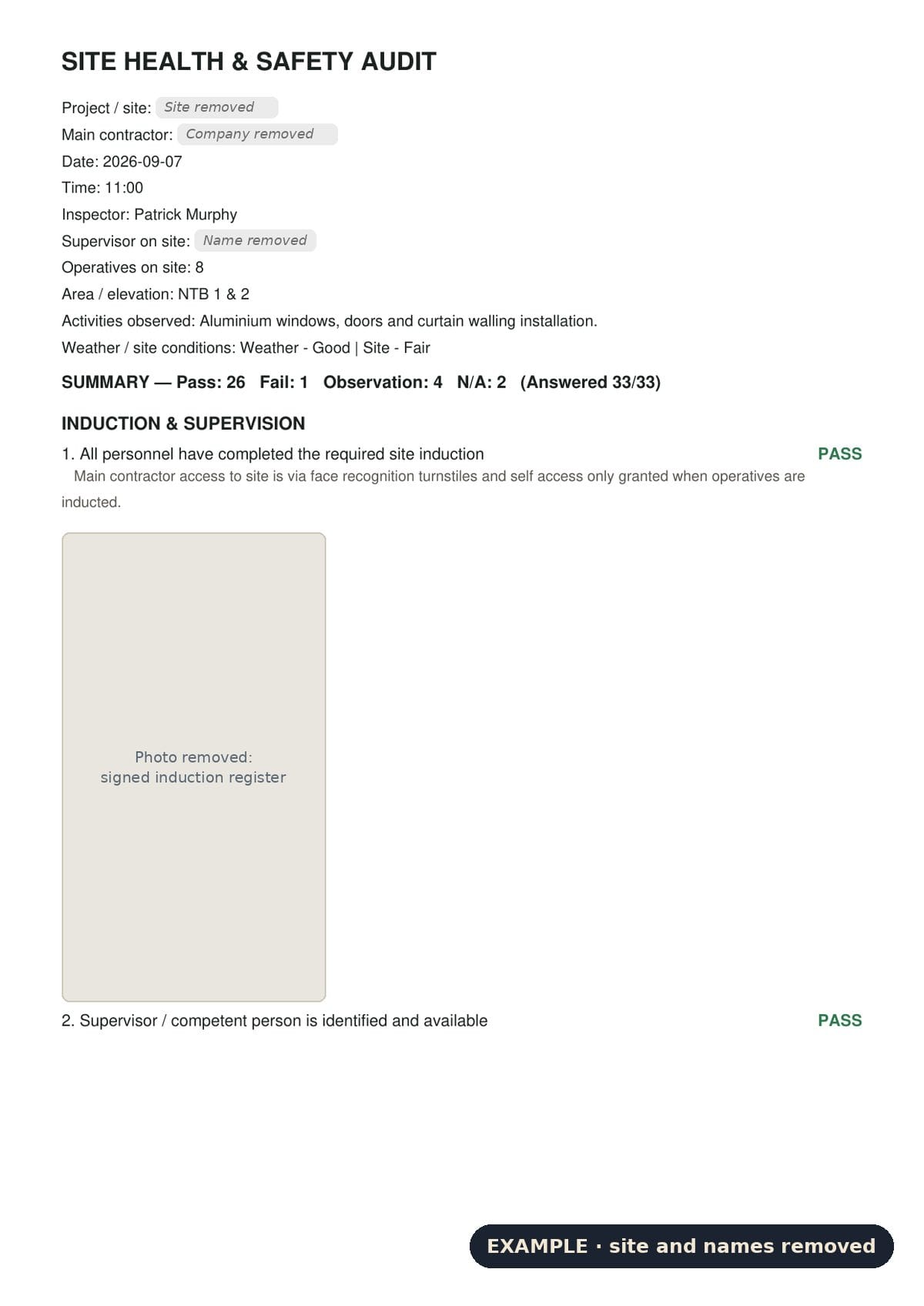
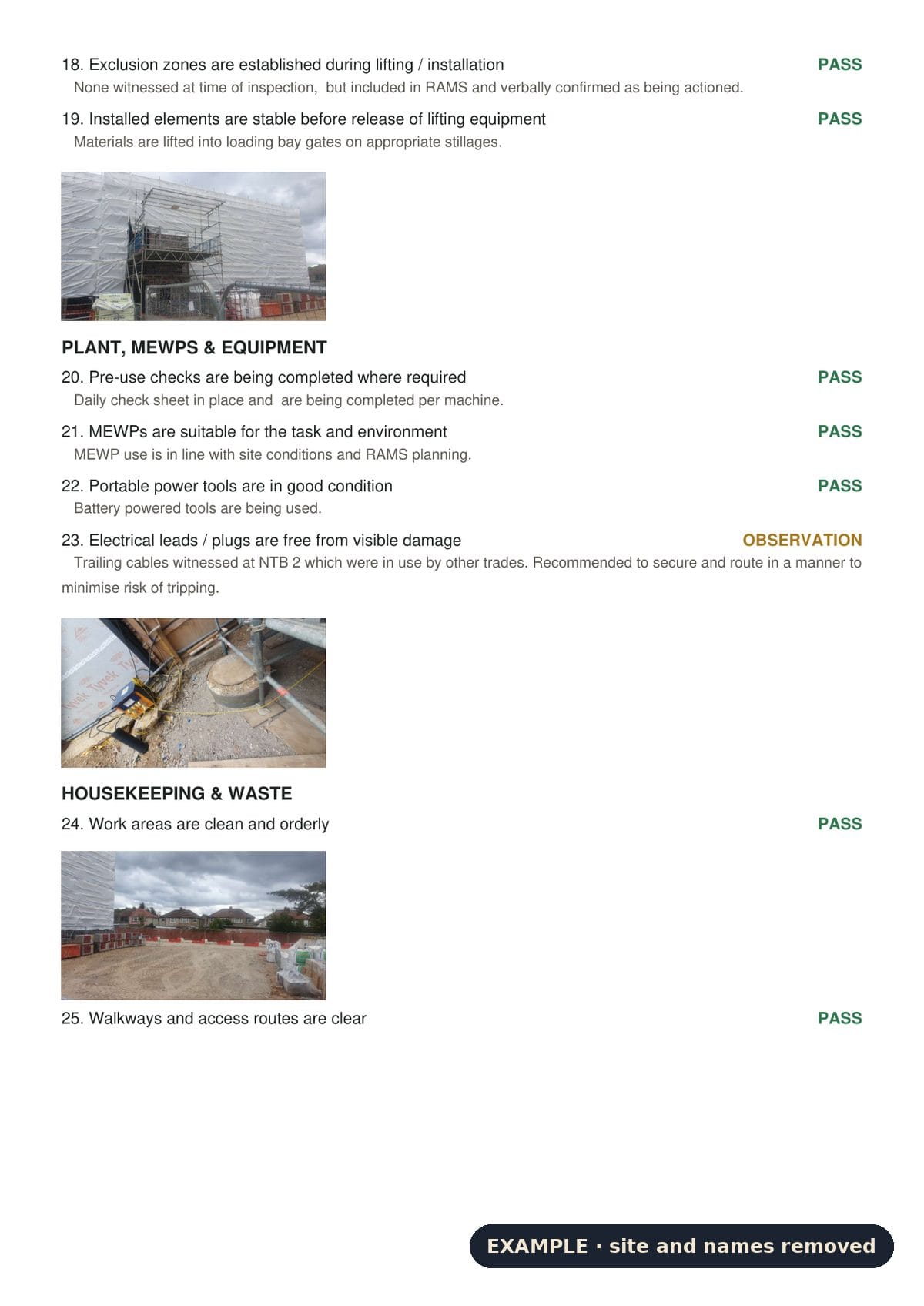
  • What we checkInductions and supervision, RAMS, PPE, working at height, plant and tools, housekeeping, fire routes, dust and actions left over from last time. The site audit shown here covered 33 questions.
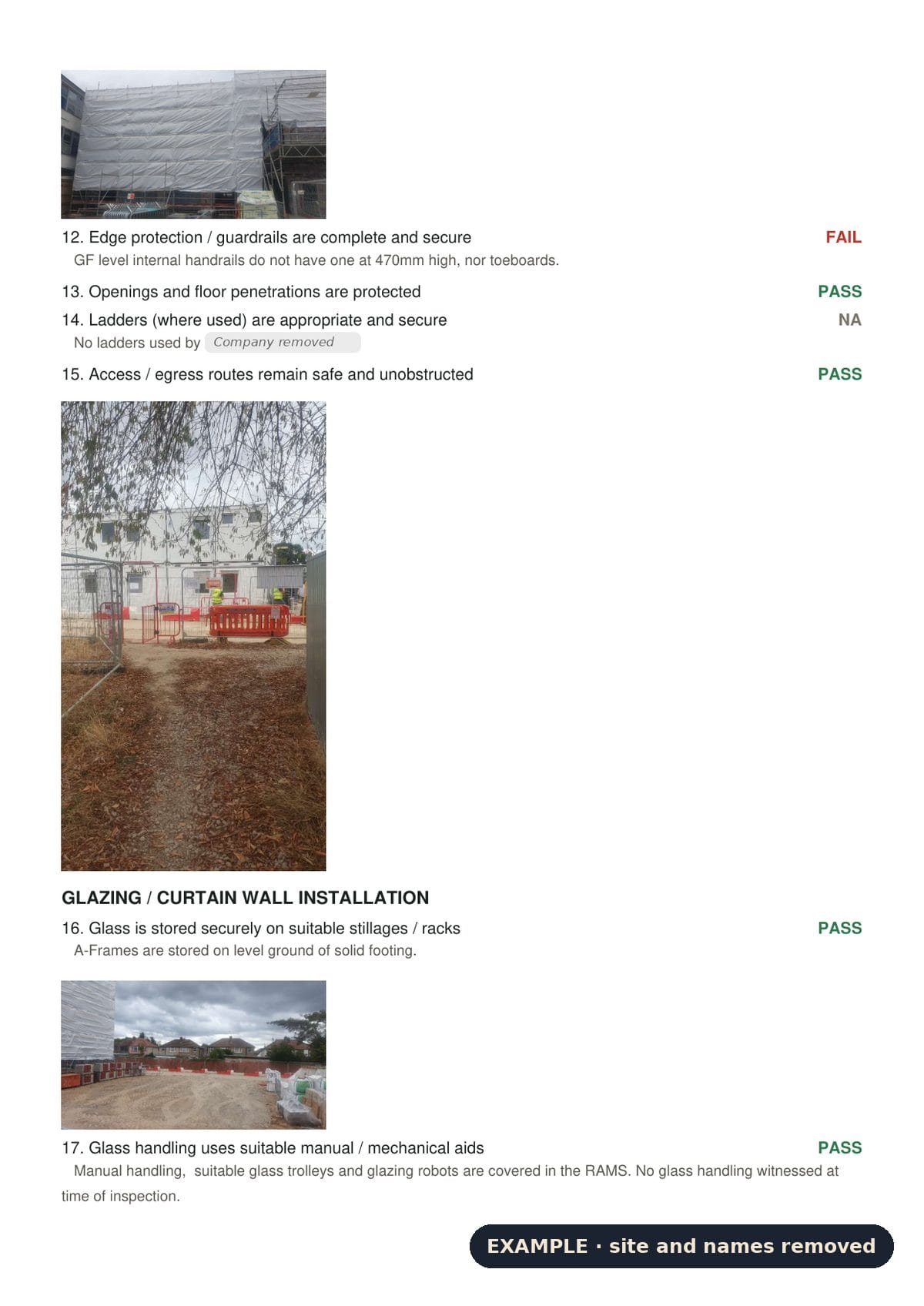
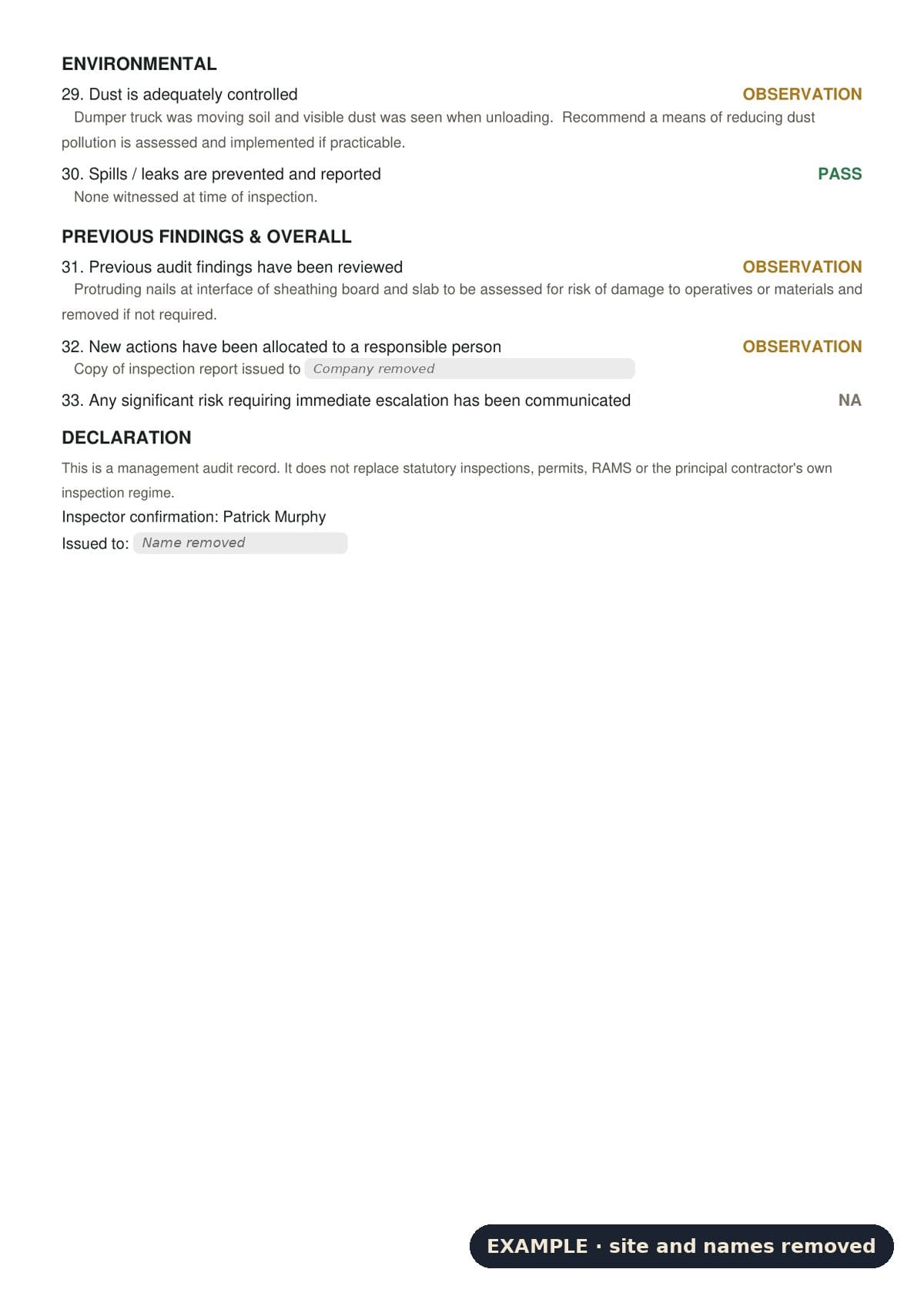
  • What you get backEvery check marked pass, fail or observation, with a note and photo evidence, and a one-line summary at the top.
  • What you do with itPut the fails right first, act on the observations, and keep the report as dated evidence that the work was checked.
Example site audit summary: 33 questions answered, 26 pass, 1 fail and 4 observations, with the site details removedExample site audit page: a fail for missing mid-rails and toe boards on internal edge protection, with photos of the scaffold and site accessExample site audit page: plant and equipment checks, with an observation about trailing cables and photos of the work areasExample site audit page: observations on dust and earlier findings, and the closing declaration signed by the inspector
An example of our site audit format, from a recent inspection by Patrick. Site, company and personal details removed. Tap a page to see it full size.

Who this is for

Two audiences, one set of problems.

Whether you are holding the duties or paying the invoices, what you need is the same: to know what is actually required, and to have proof it was done.

For contractors and small builders

You are being asked for paperwork you did not have time to write.

Small sites carry the same duties as large ones and almost none of the support. We work at the scale you are actually operating at — a loft conversion, a rear extension, a shop fit-out, a run of maintenance contracts — and leave you with documents you can maintain yourself afterwards.

  • RAMS written around your real sequence of work, not a template with the site name changed
  • CDM 2015 duties mapped to your project, and the paperwork that proves they were met
  • Site inspections and walk-rounds with a dated written report and photographs
  • Toolbox talks delivered on site, in language the crew actually engages with
  • Accident and near-miss reporting set up so it takes minutes, not an afternoon
  • Construction Phase Plans that are short, specific and usable

For homeowners, landlords and self-builders

Somebody in your corner while they build on your property.

Your builder, their subcontractors and often your designer all share the same commercial interest. You do not have anyone independent reading the quote, watching the stages where problems get buried, or checking the certificates before the final payment leaves your account. That is the gap we fill, and an independent report costs a fraction of one variation.

  • Contractor vetting before you sign — company status, insurance, registrations, references
  • Quote comparison that shows you what has been excluded, because that is where variations come from
  • Independent stage inspections timed for foundations, first fix, insulation and pre-plasterboard
  • Materials and method sense-checks when something you have been told does not sound right
  • Certificate audits — Gas Safe, Part P, FENSA, Building Regulations completion
  • A dated photographic record you keep on file for your insurer, or for a future sale

Scope

What we typically cover.

Take one of these on its own, or several as a package. Every engagement ends with something written down and dated.

01

Site safety inspections & walk-rounds

An independent set of eyes on the site, with a written, dated report you can put straight on file.

We walk the site the way an inspector would: access and egress, edge protection, working at height, scaffold handover tags, electrics and temporary supplies, welfare, PPE, housekeeping, plant and lifting, COSHH storage and fire precautions. You get findings ranked by what actually matters, each with a practical fix and a sensible timescale — not a 40-page dump of legislation.

  • Photographic inspection report, dated and referenced
  • Findings ranked high / medium / low with fixes
  • Action list with owners and target dates
  • Close-out confirmation once items are cleared

From £295

02

RAMS review & authoring

Risk assessments and method statements that are site-specific, readable, and defensible.

Generic RAMS downloaded from a template site are the single most common reason a principal contractor sends work back. We either review what you have and mark it up, or write it from scratch around your actual sequence, plant, access and people — including COSHH assessments, safe systems of work and task-specific method statements. Written so the operative on the tools can follow it and the client's H&S adviser can sign it off.

  • Site-specific risk assessment and method statement
  • COSHH assessments for the materials in use
  • Sequence, plant, access and permit requirements
  • Editable master you can reuse on the next job

From £225

03

Contractor vetting & qualification checks

Find out what you're dealing with before money changes hands.

We check the things people assume and rarely verify: company status and filing history, insurance cover and expiry (public liability, employers' liability, professional indemnity), trade accreditations and scheme memberships, competence and card checks, references on comparable work, and whether the quote covers what you actually asked for. You get a plain verdict — proceed, proceed with conditions, or walk away.

  • Written vetting summary per contractor
  • Insurance and accreditation verification
  • Quote and scope comparison against your brief
  • Clear recommendation and questions to ask them

From £275

04

CDM 2015 duty-holder support

Practical help meeting client, principal designer and principal contractor duties on smaller projects.

Small projects still carry real duties. We help you work out which ones apply to you, then produce and hold the paperwork that proves they were met: pre-construction information, construction phase plan, F10 notification where notifiable, and the health & safety file at handover. For domestic clients we explain exactly where your duties transfer and where they do not.

  • Duty-holder map for your project
  • Pre-construction information pack
  • Construction phase plan review or drafting
  • Health & safety file at completion

From £750

05

Quality assurance & programme support

Inspection and test plans, hold points and a programme that reflects reality.

We set up light-touch QA that fits a small team: inspection and test plans tied to the build sequence, hold points before things get covered up, materials and workmanship benchmarks, and a simple record trail. On programme, we sanity-check durations, sequencing and the dependencies that usually cause the slip — long-lead items, inspections, and trades tripping over each other.

  • Inspection and test plan with hold points
  • Benchmark and sign-off records
  • Programme sense-check with critical-path notes
  • Progress reporting template

From £450

06

Materials & methods sense-check

Is what's being installed the right thing, fitted the right way?

We check the specification against the use — fire performance and product certification, manufacturer installation requirements, compatibility, warranty conditions, and whether the detail actually works on your building. Common findings: unsuitable substitutions accepted on price, missing certification for products in a fire-rated build-up, and installation that voids the warranty nobody has read.

  • Specification and certification check
  • Installation-versus-manufacturer-requirement notes
  • Substitution risk assessment
  • Written recommendation you can hand your builder

From £250

07

Project monitoring visits

Recurring visits through the build, with evidence captured as you go.

For anyone who cannot be on site every week — homeowners, landlords, small developers, or a contractor stretched across jobs. Agreed-frequency visits with photographic progress records, safety and quality observations, and an action log carried forward so nothing quietly disappears between visits.

  • Visit report with photographic record
  • Rolling action log with close-outs
  • Safety and quality observations
  • Escalation call whenever something needs a decision

From £295 per visit

08

Practical problem-solving & dispute support

Something has gone wrong. You need the facts written down properly.

Defective work, a stalled job, a contractor who has stopped answering, or a dispute heading somewhere expensive. We inspect, record what is actually there against what was specified and paid for, and set it out in a factual, measured report — the kind that helps a negotiation, an insurer or a solicitor rather than inflaming it.

  • Factual condition and defects report
  • Comparison against contract, spec and quote
  • Remedial scope and indicative cost
  • Documentation suitable for third-party review

From £395

Where it goes wrong

The rules that usually bite.

We quote regulation where it matters and translate it everywhere else. You should be able to hand our report to your team and have them act on it the same week.

CDM 2015

Who is the client, principal designer and principal contractor on your job — and what each of them actually has to produce. It applies to domestic projects too, with no minimum size.

Work at Height Regulations 2005

Scaffold inspection records, ladder use, edge protection, and the paperwork that shows a competent person signed it off on the right date.

Building Regulations & inspection points

Where building control sign-off sits in your programme, and what evidence you should be collecting as you go rather than reconstructing afterwards.

Construction Phase Plan

A proportionate plan for a small site — short, specific and usable — instead of sixty pages nobody on site has opened.

If you are the property owner

Four things homeowners do not expect.

None of this is scaremongering. It is the same four issues we find on domestic projects across Kent, every year.

01

No Construction Phase Plan on a domestic job

The duty sits with the contractor, but plenty of small domestic projects run with nobody having written one. That makes the project non-compliant from day one. You are not expected to write it — you are expected to have checked it exists.

02

An electrician who is not registered

Anyone can call themselves an electrician. Notifiable work needs a competent-person scheme member or a building control application, and without either you cannot get a compliant certificate.

03

Missing FENSA or CERTASS on new glazing

Replacement windows and doors need registered installation or a building control sign-off. It surfaces during a sale, years later, and it is expensive to fix retrospectively.

04

Contractor insurance that does not cover it

A certificate in the van is not proof of current cover, or of cover at the right level for your job. Expiry dates and cover limits are the two things nobody checks.

Indicative fees

What the common jobs cost.

Starting points, fixed in writing after the free call. The full table is on the pricing page.

ServiceBasisFrom
Contractor vetting pack (up to 3 contractors)Per pack£275
Quote comparison and scope reviewPer review£165
Independent stage inspectionPer visit£295
Certificate and paperwork auditPer property£195
Construction Phase Plan (domestic)Per project£295
Multi-visit project package — 4 visitsPer project£895

Advice

Written up in plain English.

The questions we answer most often, explained properly rather than in a sales page.

Landlords

EPC C by 2030: what a Thanet landlord should do this year

The Government confirmed it in January 2026: every private tenancy needs EPC C by 1 October 2030, with spending capped at £10,000 a property. Four years sounds like plenty. For an older Thanet terrace, it is about the right amount of time to do it properly.

Homeowners

A £200,000 bill for a wall that should never have come down

Supporting timbers and steels came out while chimney breast works were still open, with no temporary propping. The gable wall collapsed. The builder was sentenced — but because his public liability cover was invalid, the homeowner paid £200,000 to rebuild their own house.

Construction

The open roof light: £60,000 for a hole nobody covered

No barrier, no crash deck, no scaffold, no harness — just an open roof light and a man passing materials down through it. The HSE inspector called it wholly avoidable. It is also exactly the kind of thing an outside pair of eyes spots in ten minutes.

Construction

They cut the railings out on Monday. He fell through on Tuesday.

The railings came out to allow the steps to be replaced. Nothing went in their place. The next day a 65-year-old bricklayer fell through the gap into a basement lightwell 2.6 metres below. There was no task-specific risk assessment or method statement for the job.

Common questions

What builders and homeowners ask us first.

Can you write RAMS for my job?

Yes, and they are written around your actual job rather than pulled from a template library. That means your real sequence of work, your plant and access arrangements, your site constraints and the people who will actually be doing it. The single most common reason RAMS get rejected by a principal contractor is that they are generic documents with the site name changed — obvious to anyone reading them properly. First activity-specific document from £225, with additional related activities from £95 each.

What are my CDM 2015 duties, in one paragraph?

CDM 2015 applies to all construction work in Great Britain, including domestic projects, with no minimum size or value. If you are having work done you are the client, and you must make suitable arrangements for managing the project, provide pre-construction information and satisfy yourself that whoever you appoint is competent. Where more than one contractor is involved you must appoint a principal designer and a principal contractor in writing, and a Construction Phase Plan must exist before work starts. On domestic projects your client duties pass automatically to the contractor, or to the principal contractor where there are several — that is the legal default, not something you have to arrange. If you do not appoint a principal designer or principal contractor yourself, the designer and contractor in control of those phases take on the roles by default. You can instead agree in writing for the principal designer to take on your client duties. HSE's guidance for domestic clients sets this out in full. We map exactly which duties sit with you on your project and produce the paperwork that proves they were met.

I'm a homeowner — do I need a Construction Phase Plan?

A Construction Phase Plan must exist for the project, and this is where domestic clients get caught out. The duty to produce it sits with the contractor, or with the principal contractor where more than one contractor is involved — but plenty of small domestic jobs run with nobody having written one at all, which means the project is non-compliant from day one and there is no documented plan if something goes wrong. You are not expected to write it yourself. You are expected to have satisfied yourself that it exists. Ask for it before work starts, and if nobody can produce one, that tells you something useful about how the rest of the job will be run. We produce proportionate plans for domestic and small commercial projects from £295 — short, specific and usable, not sixty pages nobody opens.

Can you check my builder before I sign?

Yes. A contractor vetting pack covers company status and trading history at Companies House, the validity and cover level of their public liability and, where relevant, professional indemnity insurance, the trade registrations and accreditations they claim, whether their qualifications are current rather than expired, and their enforcement history where it is on the public record. We also read the quotation itself and tell you what is excluded from it, because that is where variations come from later. Up to three contractors from £275, additional contractors £75 each.

Can you check the certificates I've been given?

Yes, and it is worth doing before you make the final payment or put the property on the market. We verify Gas Safe certification against the register, Part P and electrical installation certificates including whether the certificate type actually matches the work carried out, FENSA or CERTASS registration for replacement glazing, and Building Regulations completion certificates. The point worth knowing: an invoice is not a certificate, and a compliment slip with a logo on it is not a certificate either. Missing paperwork surfaces at exactly the wrong moment — usually during a sale, or when you make an insurance claim. Paperwork audit from £195.

Contact

Tell us about the site, or the build somebody is doing for you.

Where it is, what stage it is at, and who is asking for what. We will tell you what is involved, what it costs, and whether you need us at all.

We work across Thanet — Margate, Cliftonville, Westbrook, Garlinge, Westgate-on-Sea, Birchington, Broadstairs, St Peters, Kingsgate, Ramsgate and the surrounding villages — and regularly across East Kent including Canterbury, Whitstable, Herne Bay, Faversham, Sandwich, Deal. Travel is included within twenty miles of Margate.